MentalDepressionMindfulness
"It's an illness, and you get better": what JK learned about depression
By 2nd Half · 8 min read · Nov 11, 2026
Sir John Kirwan was one of the most feared wingers the game has seen. He played for the All Blacks from 1984 to 1994 and won a World Cup. From the outside, he had the kind of life most Kiwi blokes would happily swap for their own.
On the inside, he was in trouble. JK has described his lowest moment as being alone in a hotel room in Buenos Aires on an All Blacks tour, no longer sure he wanted to be here. He got through that night, and what eventually turned his life around wasn't toughness. It was a simple idea that took him years to accept: depression is an illness, and you get better from it. It is one of the most useful things a man in the second half of life can understand about his own mental health.

The weakness story we were sold
Plenty of men our age grew up with an unwritten rule that you don't talk about it. You harden up, get on with it, and keep anything that feels wrong in your head to yourself, as if it were a character flaw.
JK lived by that rule for years. In his own telling, the shift came when he stopped seeing what was happening to him as weakness and started seeing it as illness. That reframe matters because it changes what you do next. Nobody feels ashamed of a broken leg; they get it looked at, follow the plan and expect it to heal.
His memoir, All Blacks Don't Cry, first published in 2010, laid all of this out in plain language and became a bestseller. JK had also fronted the Government's National Depression Initiative TV campaign, which began in 2006. For a lot of New Zealand men, seeing an All Black say "this happened to me" was the first time the subject felt allowed.
What the numbers say about Kiwi men now
Twenty years on, the conversation is more open, but the need has, if anything, grown.
In the 2023/24 New Zealand Health Survey, 10.2% of men reported high or very high psychological distress in the previous four weeks. In 2011/12, the figure was 3.7%.
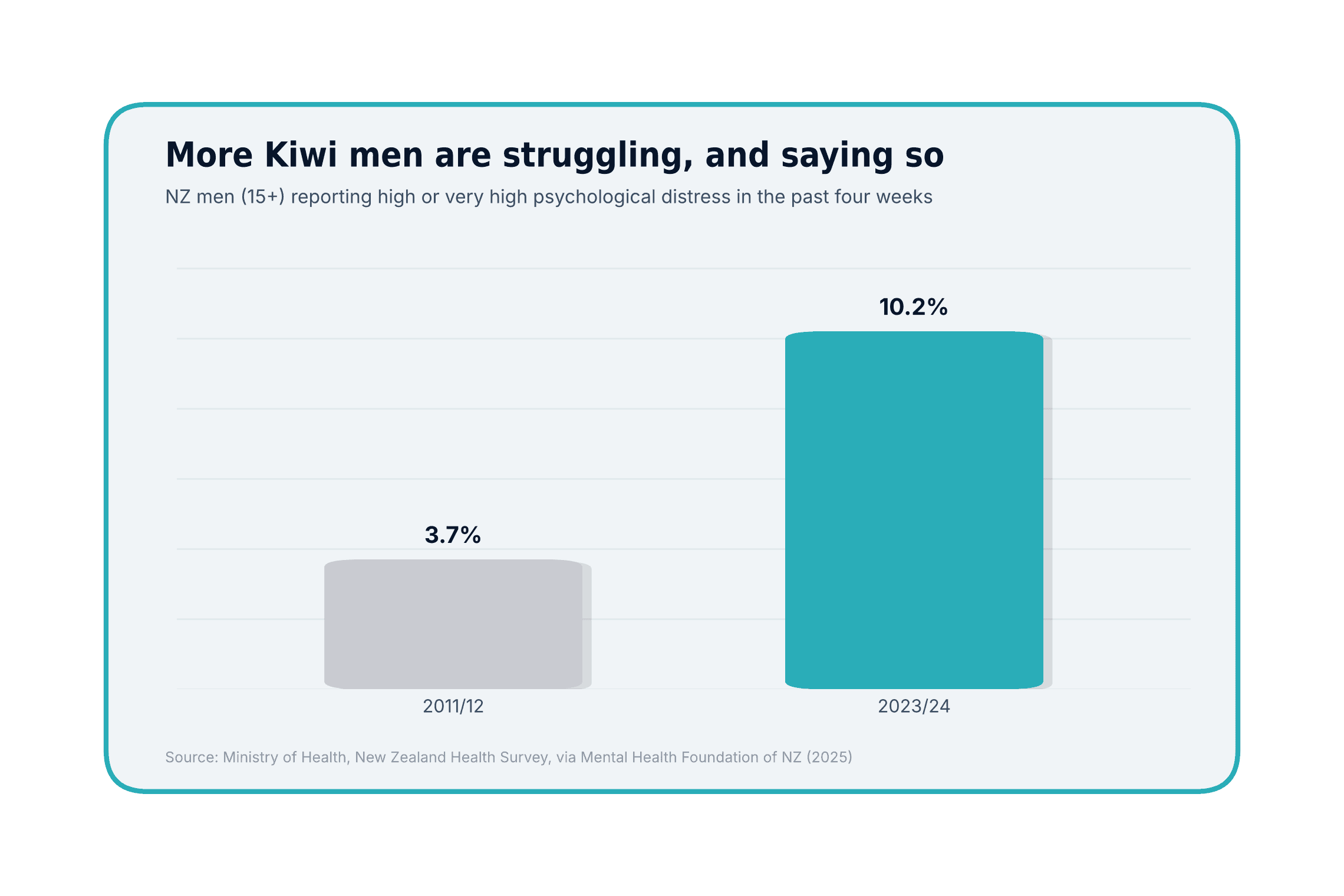
It is worth being careful about what that chart shows. The survey measures recent distress (symptoms of anxiety and depression over four weeks), not diagnosed depression, and some of the rise may simply reflect men being more willing to tick the box, which would itself be progress. Either way, it suggests roughly one man in ten is doing it tough at any given time, which likely includes someone at your next barbecue.
Men are also still less likely than women to seek help. The Mental Health Foundation points to the same barriers JK describes: not recognising that a problem has become a problem, not knowing where to go, and the old stoicism that says to put on a brave face.
Why "you get better" holds up
This part of JK's line is backed by solid evidence. Depression is one of the most researched conditions in medicine, and it responds to treatment.
One example is a 2014 meta-analysis that pooled 26 randomised controlled trials, involving 1,524 people, on a talking therapy called behavioural activation. It found the approach clearly outperformed control conditions for reducing depressive symptoms. Behavioural activation rests on an idea JK would recognise: rather than waiting to feel better before doing things, you do small, meaningful things and let the feeling follow.
That is one therapy among several. Medication, other talking therapies, exercise and social connection all have a place, and what works best varies from man to man. What matters is that there are options, and most of them help most people.

From recovery to prevention
Once JK was well, he became interested in the other end of the problem: what you do every day so you are less likely to end up back in the hole.
That thinking became Groov, the wellbeing company he co-founded, and its framework of six pillars: Chill, Do, Connect, Move, Celebrate and Enjoy. As Groov puts it, the idea is to do something small from each pillar every day, so you feel good, function well and bounce back from stress. JK's own version is simpler still: start with one thing, and once that is part of your day, add another.
This is the part 2nd Half cares about most. Recovery is vital, but in the second half of life the bigger win is building daily habits that protect your head in the same way strength training protects your bones.
The honest caveats
JK's story is one man's experience. It is powerful and generously shared, but it is not a treatment plan, and your path may look different.
The survey figures describe distress rather than diagnosis, and they are self-reported. The upward trend is real, but its exact causes are still debated.
The therapy evidence is strong for depression as a group, but individual results vary, and some men need to try more than one approach before something sticks. That is normal rather than a sign of failure. And nothing here replaces a conversation with your GP or a trained counsellor.
What to actually do
Name it. If you have felt flat, irritable, numb or hopeless for more than a couple of weeks, say so out loud to someone you trust. JK's turning point was calling it what it was.
Treat it like an injury. Book a GP appointment the way you would for a dodgy knee, and tell them plainly how you have been feeling.
Use the free line. In New Zealand you can call or text 1737 any time of the day or night to talk with a trained counsellor, free of charge. If you or someone else is in immediate danger, call 111.
Start with one thing. A walk, a call to a mate or an early night all count. Something small and doable beats a big plan you abandon.
Look after a mate. If someone in your life has gone quiet, check in. You don't need the right words, because asking is itself the help.
The second half is not the end of the story
JK has spoken about being to hell and back, and about hope being the thing he hung on to. What stands out about his story now is less the darkness than how ordinary the way out was: calling it an illness, getting help, and then doing small things every day to stay well.
That path is open to every one of us. The second half of life is long, and it can be the best half. Looking after your head is how you make sure you are around, and present, to enjoy it.
This article is for general information and isn't medical advice. If you are worried about your mood or someone else's, talk to your GP, or free call or text 1737 any time. In an emergency, call 111.
2nd Half. The best is yet to come.
2NDHALF.CO.NZ
Sources
- Groov (2024). Sir John Kirwan talks contact centre agent wellbeing, performance and Groov on the Get Out of Wrap podcast. Groov blog (opens in new tab)
- Groov. The 6 pillars of mental wellbeing. Groov blog (opens in new tab)
- Groov. Weave wellbeing habits into your day with DOT then DAT. Groov (opens in new tab)
- Kirwan, J. (2023). All Blacks Don't Cry: A Story of Hope (revised edition). Penguin Random House (opens in new tab)
- Scoop (2012). Sir JK opens up with Attitude. Scoop (opens in new tab)
- Mental Health Foundation of New Zealand (2025). Statistics on men's mental health and wellbeing, drawing on the Ministry of Health New Zealand Health Survey 2023/24. Mental Health Foundation (opens in new tab)
- Ekers, D., Webster, L., Van Straten, A., Cuijpers, P., Richards, D. and Gilbody, S. (2014). Behavioural activation for depression; an update of meta-analysis of effectiveness and sub group analysis. PLoS One

2nd Half
More articles

Connection
The longevity tactic nobody puts on their list: your mates
By 2nd Half · 7 min read
Longevity
Your Real Age Isn't on Your Driver's Licence: Biological Age vs Birth Age for NZ Men in 2026
By 2nd Half · 7 min read

Longevity
Your Chair Is the Problem: How Sitting More Than 10 Hours a Day Raises Dementia Risk for NZ Men
By 2nd Half · 7 min read