LongevityPhysicalHealth
Your Real Age Isn't on Your Driver's Licence: Biological Age vs Birth Age for NZ Men in 2026
By 2nd Half · 7 min read · Nov 10, 2026
Picture two Kiwi men born in the same year, in the same hospital, who grew up a few streets apart. Their licences give the same birthday, but by their late 30s one has the body of a man in his late 20s and the other has the body of a man pushing 60.
That isn't a thought experiment. It's what researchers found when they looked closely at a group of New Zealanders who have been studied since birth, and it's one of the most hopeful findings in ageing research, because the gap between those two men isn't fixed.

Two kinds of age
Your chronological age is a timestamp. It tells the bank how long ago you were born and tells the Government when you qualify for NZ Super. It says very little about the condition of the body carrying you around.
Biological age is an estimate of that condition. Researchers calculate it from measurements such as blood pressure, lung function, cholesterol, blood sugar control, kidney and liver function, inflammation markers and, more recently, chemical tags on your DNA. Put together, those numbers give a picture of how far your body has travelled, which can be quite different from how many birthdays you have had.
What the Dunedin Study found
Some of the best evidence on this comes from right here. The Dunedin Multidisciplinary Health and Development Study has followed 1,037 people born in Dunedin in 1972 and 1973 since birth, with remarkably few dropping out over the decades.
In 2015, the research team calculated a biological age for 954 study members when they were all 38 years old. The results ranged from 28 to 61.
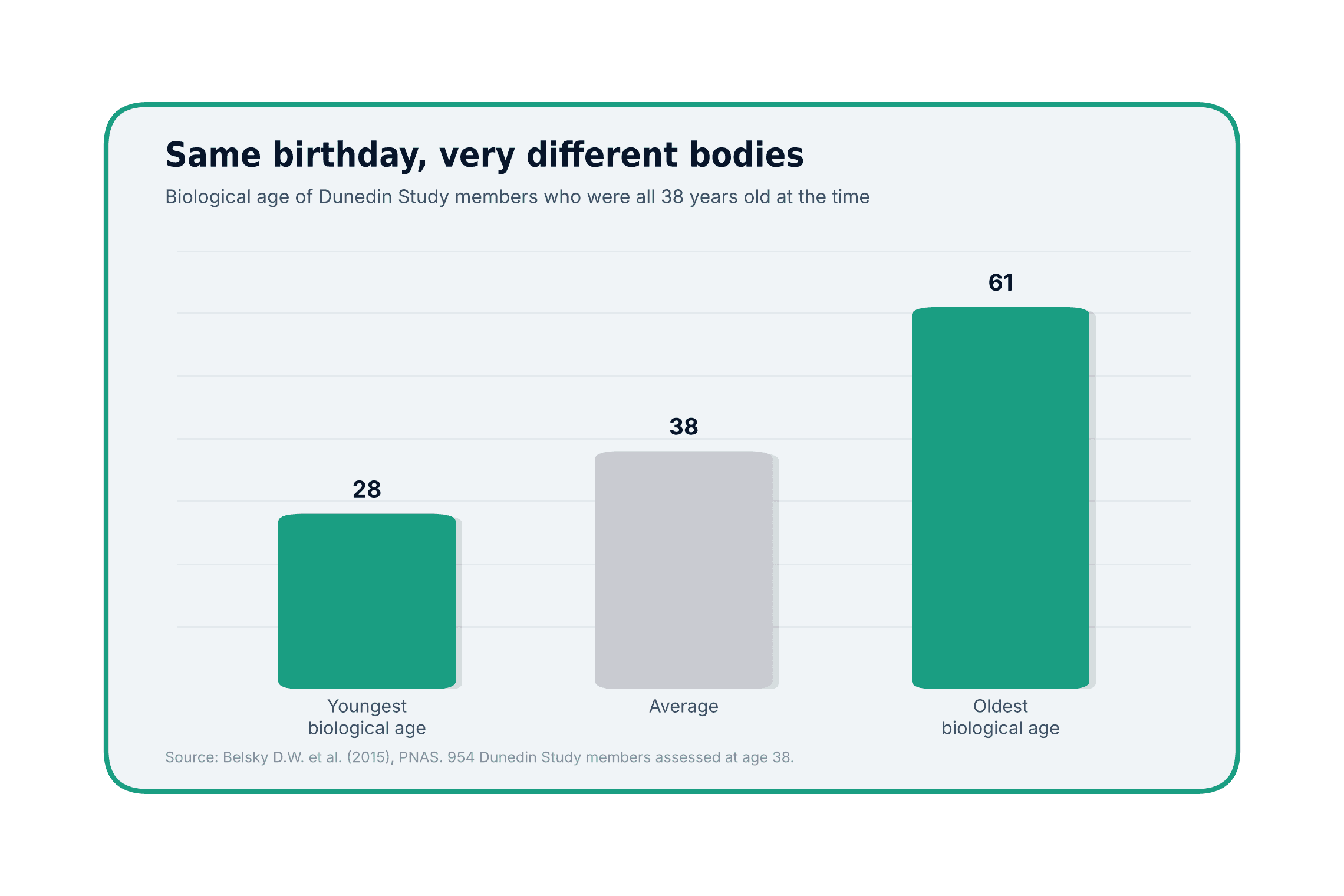
The team also tracked how quickly each person's body had changed between ages 26 and 38. Most aged at about one biological year per calendar year. Some barely aged at all, while others aged two to three years for every year that passed. The faster agers were already showing it in ways that matter day to day: on average they had poorer balance and coordination, more trouble with unfamiliar problems, and they were rated as looking older from their photos.
The Dunedin team later turned this work into a blood test called DunedinPACE, which estimates how fast someone is ageing right now from patterns on their DNA. In other large studies, a faster DunedinPACE has been linked with a higher risk of chronic disease, disability and death.
Why "I feel fine" isn't a measurement
Most men in their 40s and 50s judge their age by how they feel after a bad night's sleep or a long day on the tools. The trouble is that feeling lags well behind the biology.
Rising blood sugar can sit silently for years before it becomes type 2 diabetes. Blood pressure can creep up without a single symptom. Muscle and balance can quietly slip until the day a stumble becomes a fall. The internal clock keeps running on all of these fronts while "feeling fine" still reads green.
What moves the dial
The good news running through this research is that pace of ageing isn't set at birth. A few areas come up again and again.
Fitness and strength. Cardiorespiratory fitness is one of the strongest predictors of how long people live, and muscle matters too. In a study of almost 140,000 adults across 17 countries, grip strength predicted death from any cause and from heart disease better than systolic blood pressure did.
Regular sleep. A 2024 UK study of more than 60,000 adults found that keeping a consistent sleep and wake pattern was a stronger predictor of mortality risk than how many hours people slept.
Blood sugar. Blood tests from a national New Zealand nutrition survey found that 18.6% of adults, nearly one in five, had prediabetes. Because it has no symptoms, many people with it don't know, and it's one of the most common ways biological age gets ahead of the calendar.
People. A 2025 study of more than 2,200 older adults found that those with high social engagement had a lower risk of dying over four years, and that slower biological ageing explained part of that link.
There is also early trial evidence that pace can shift. In the CALERIE trial, healthy adults who cut their calorie intake for two years showed a modest slowing, of about 2 to 3%, on the DunedinPACE measure compared with a control group.
The honest caveats
Biological age is a research tool first. Different measures (blood biomarker scores, DNA methylation "clocks") don't always agree with each other, and the numbers carry real uncertainty for any one individual.
Consumer epigenetic tests are now sold online, but they aren't a medical test, results can vary between labs, and a single number shouldn't drive big decisions. The standard checks your GP can do are a more practical starting point.
Most of the links described above come from observational studies. Fit, well-connected people who sleep regularly tend to do lots of other healthy things too, so the effects overlap. And the CALERIE finding was small and came from a demanding diet most people couldn't sustain. Its value is in showing that the pace of ageing can move at all.
How to find out where you stand
Get the basics checked. Ask your GP about a heart and diabetes check, which covers blood pressure, cholesterol and blood sugar (HbA1c). Note your waist measurement while you are at it.
Test your strength and balance. Notice whether you can get up off the floor without using your hands, and whether you can stand on one leg for 30 seconds. Both are simple, telling signs.
Check your fitness. Many smartwatches estimate your VO2 max. Treat the number as a rough guide and watch the trend over time rather than the exact figure.
Then pick one lever. Strength training twice a week, a regular bedtime, fewer sugary drinks or a weekly catch-up with mates will each push the dial in the right direction.
Your biological age is a number you can change
Your birth certificate won't change. Your biological age can, and the Dunedin research shows how wide the gap can be between men born in the same year in the same town.
The men who reach 80 strong, sharp and still themselves aren't simply the lucky ones. Mostly, they are the ones who at some point in their 40s or 50s started treating age as something they could measure and influence, rather than a date on a licence.
This article is for general information and isn't medical advice. Talk to your GP about which health checks are right for you.
2nd Half. The best is yet to come.
2NDHALF.CO.NZ
Sources
- Belsky, D.W., Caspi, A., Houts, R. et al. (2015). Quantification of biological aging in young adults. Proceedings of the National Academy of Sciences (opens in new tab), summarised by the Dunedin Study (opens in new tab)
- Belsky, D.W., Caspi, A., Corcoran, D.L. et al. (2022). DunedinPACE, a DNA methylation biomarker of the pace of aging. eLife (opens in new tab)
- Leong, D.P., Teo, K.K., Rangarajan, S. et al. (2015). Prognostic value of grip strength: findings from the Prospective Urban Rural Epidemiology (PURE) study. The Lancet (opens in new tab)
- Windred, D.P., Burns, A.C., Lane, J.M. et al. (2024). Sleep regularity is a stronger predictor of mortality risk than sleep duration: a prospective cohort study. Sleep (opens in new tab)
- Coppell, K.J., Mann, J.I., Williams, S.M. et al. (2013). Prevalence of diagnosed and undiagnosed diabetes and prediabetes in New Zealand: findings from the 2008/09 Adult Nutrition Survey. New Zealand Medical Journal (opens in new tab), summarised by the University of Otago (opens in new tab)
- Abugroun, A. et al. (2025). Low social engagement and risk of death in older adults. Journal of the American Geriatrics Society, summarised by

2nd Half
More articles

Longevity
Your Chair Is the Problem: How Sitting More Than 10 Hours a Day Raises Dementia Risk for NZ Men
By 2nd Half · 7 min read

Mental
"It's an illness, and you get better": what JK learned about depression
By 2nd Half · 8 min read

Connection
The longevity tactic nobody puts on their list: your mates
By 2nd Half · 7 min read