LongevityDementiaMental Wellbeing
Your Chair Is the Problem: How Sitting More Than 10 Hours a Day Raises Dementia Risk for NZ Men
By 2nd Half · 7 min read · Nov 10, 2026
Picture a fairly normal Tuesday. You drive to work, sit at a desk for most of the day, drive home, eat dinner on the couch and watch something before bed. You might even have squeezed in a lunchtime run.
Most of us wouldn't think twice about a day like that. But a growing body of research suggests that the total time we spend sitting may matter for our brains, not just our hearts, and that the run doesn't fully cancel it out. The good news is that this is one of the easier risks to start chipping away at.

The study that put a number on it
In 2023, researchers led by David Raichlen at the University of Southern California published a study in JAMA using data from the UK Biobank. Almost 50,000 adults aged 60 and over wore a wrist activity monitor around the clock for a week. The researchers then followed them for an average of nearly seven years to see who was diagnosed with dementia.
The pattern wasn't a straight line. Up to about 10 hours of sedentary time a day (waking time spent sitting or lying, not including sleep), the risk barely moved. Beyond that, it climbed quickly. Compared with people at the median of about 9.3 hours a day, those averaging 10 hours had an 8% higher risk of dementia, those at 12 hours had a 63% higher risk, and those at 15 hours had more than three times the risk.
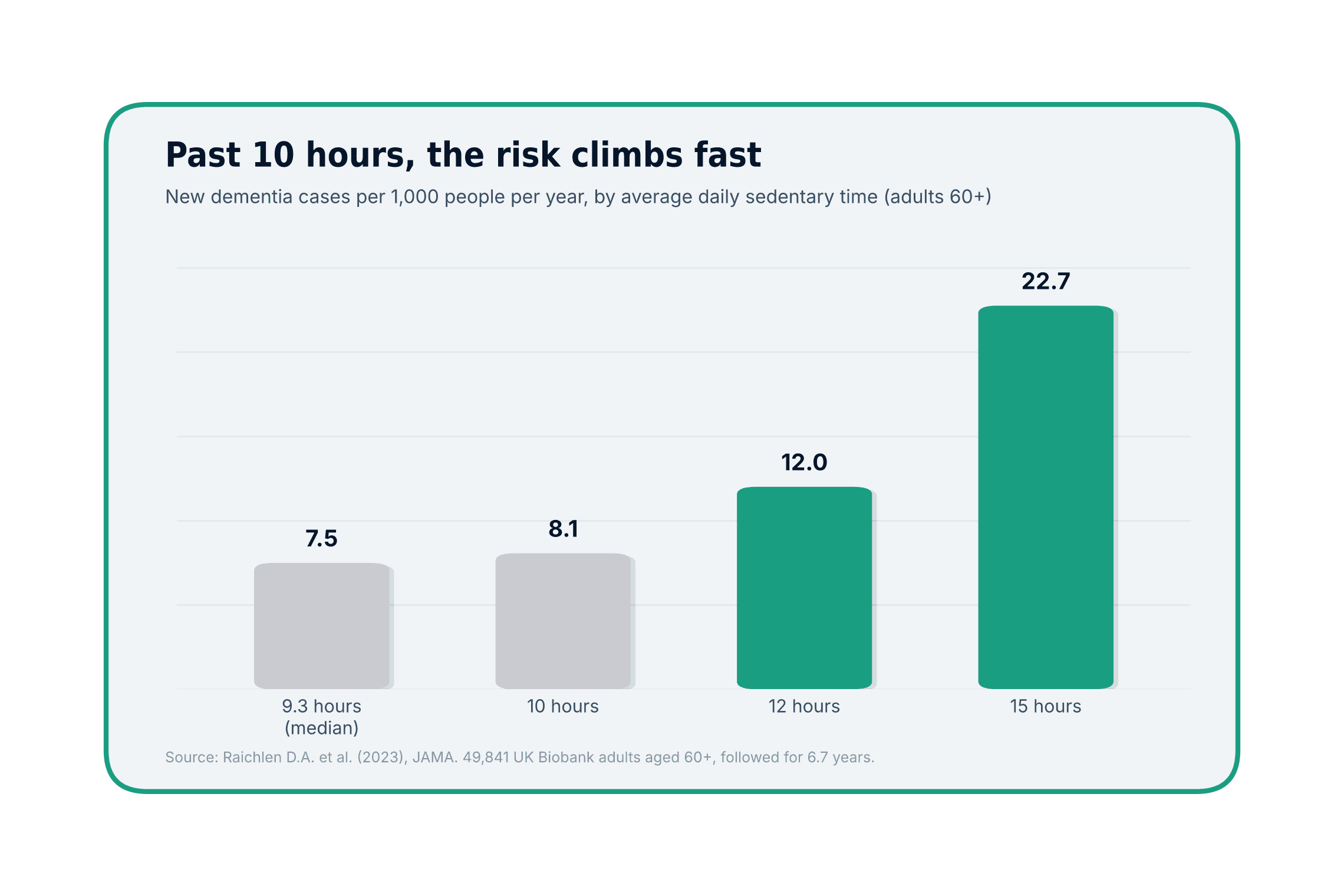
Two other findings stood out. First, the link held up after the researchers accounted for how much moderate to vigorous exercise people did, which suggests a workout doesn't fully offset a very long day in the chair. Second, the number of separate sitting periods in a day didn't change the risk. Once total sitting time was taken into account, it mattered more how many hours people sat in total than how often they got up.
Why this matters here
Dementia is one of New Zealand's biggest health challenges. Research commissioned by Alzheimers New Zealand estimates that around 83,000 New Zealanders were living with dementia in 2025, and that the number will roughly double to nearly 170,000 by 2050.
Plenty of factors feed into dementia risk, and many, such as age and genes, are out of our hands. Sitting time is different. It's something most of us can change, starting this week.
Ten hours can also add up faster than you'd think. The researchers noted that the average American is sedentary for about 9.5 hours a day, already close to the point where risk began to rise. Add a desk job, a commute and an evening on the couch, and plenty of Kiwi men would find themselves past that line.
What hunter-gatherers can teach us about resting
So is rest itself the problem? An earlier study by the same lead researcher suggests it may be more about how we rest.
In 2020, Raichlen's team fitted 28 Hadza hunter-gatherers in Tanzania with activity monitors. They spent close to 10 hours a day not moving around, which is similar to many office workers. But much of that time was spent squatting, kneeling or sitting on the ground rather than in a chair. Measurements of muscle activity showed that these "active rest" postures keep the leg muscles working at a low level, while chair sitting switches them almost completely off.
The researchers' explanation, which they call the inactivity mismatch hypothesis, is that our bodies may have evolved to rest with muscles gently engaged. Working muscles burn fuel and help clear fats and sugar from the blood, and sitting slumped in a supportive chair for hours on end may switch that process down. It's an interesting idea with some lab evidence behind it, but it remains a hypothesis for now rather than a proven explanation.

The honest caveats
The dementia study is observational, so it shows a link rather than proof that sitting causes dementia. Reverse causation is a real possibility: very early brain changes, years before a diagnosis, might make people less active rather than the other way around.
Only 414 people in the study developed dementia, and sitting time was measured over a single week. One week may not reflect someone's usual habits over years.
A wrist monitor can't tell a chair from a floor, or a crossword from a TV show. Earlier research from the same group found that TV watching was linked with higher dementia risk than computer use, which suggests what you do while sitting may matter as well.
The study included only adults aged 60 and over in the UK, so we can't assume the same thresholds apply to a 45-year-old in Hamilton. The Hadza study was small, and while the group appears to lack the chronic disease markers linked with sitting in industrialised countries, their lives also differ from ours in countless other ways.
What you can do this week
Find your number. Many smartwatches and phones track sedentary or inactive time. Check what a normal workday looks like. If you're regularly above 10 hours, that's a useful target to bring down.
Cut total sitting time, not just the occasional break. Getting up now and then is still good for you, but the study suggests total hours matter most. Swap some sitting for standing: take phone calls on your feet, use a standing desk for part of the day, or walk during meetings.
Rest more actively. Try spending some of your evening on the floor: sitting cross-legged, kneeling or resting in a supported squat while you read or watch TV. If that feels stiff, start with a cushion or a low stool and build up gradually. It's a habit that also helps keep your hips and ankles mobile.
Keep your exercise. Regular exercise remains one of the best things you can do for your brain and body. It just works on a different problem. The aim is to move more and sit less.
Watch less TV. If you do have to cut screen time somewhere, the evening box is a good place to start.
Small shifts for a sharper second half
None of this means throwing out your office chair. It means taking a more honest look at where your hours go, and nudging some of them out of the chair and onto your feet, or down onto the floor.
The brain you take into your 70s and 80s is shaped by thousands of ordinary days. Making those days a little less sedentary is one of the simplest investments you can make in staying sharp for the second half.
This article is for general information and isn't medical advice. If you're worried about your memory or thinking, talk to your GP. If you have joint or mobility problems, check with a physiotherapist before trying floor sitting or squatting positions.
2nd Half. The best is yet to come.
2NDHALF.CO.NZ
Sources
- Raichlen, D.A., Aslan, D.H., Sayre, M.K. et al. (2023). Sedentary behavior and incident dementia among older adults. JAMA (opens in new tab), summarised by Healio (opens in new tab) and MDedge (opens in new tab)
- Raichlen, D.A., Pontzer, H., Zderic, T.W. et al. (2020). Sitting, squatting, and the evolutionary biology of human inactivity. Proceedings of the National Academy of Sciences (opens in new tab)
- Alzheimers New Zealand (2025). Dementia in focus: prevalence, incidence and costs in New Zealand. Alzheimers New Zealand (opens in new tab), reported by RNZ (opens in new tab)

2nd Half
More articles
Longevity
Your Real Age Isn't on Your Driver's Licence: Biological Age vs Birth Age for NZ Men in 2026
By 2nd Half · 7 min read

Mental
"It's an illness, and you get better": what JK learned about depression
By 2nd Half · 8 min read

Connection
The longevity tactic nobody puts on their list: your mates
By 2nd Half · 7 min read